
Permaculture I: The Culture
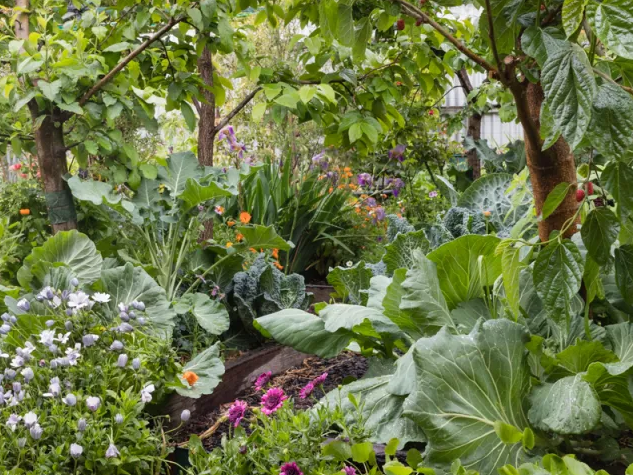
Source: Eliades, A. (2026, February 7). Deep green permaculture. [2]
What is Permaculture?
Permaculture as a term was coined by “Bill Mollison and David Holmgren in Australia in the 1970s”. [5] It originally came from the words permanent and agriculture. But, this was seen as too minimizing and thus came the word culture to describe the practice in a broader term. [5] According to Oregon State University, permaculture “is most often used for creating efficient and productive landscapes that sustain themselves into the future by regenerating biodiversity and lost fertility.”[6] There is a strong emphasis on growing food forests and providing for ourselves off the land we have, no matter how big or small. You can practice permaculture on a homestead, suburban yard, or even an apartment balcony. While this design can be applied to any landscape, this article series will focus on permaculture in the residential landscape.
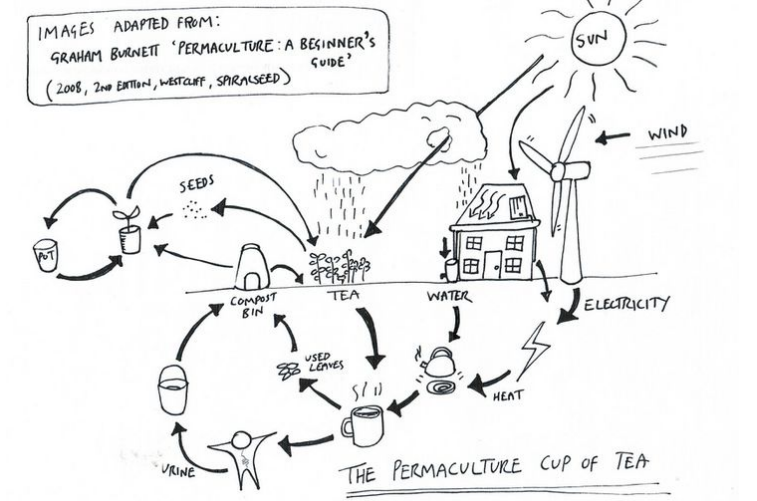
Source: Burnett, G., & Mars, J. (2008). Permaculture: A Beginner’s Guide.
Three Core Ethics
Permaculture is guided by three core ethics: 1. Earthcare, 2. Peoplecare, and 3. Fairshare. Earthcare is about doing everything you can to respect the Earth. [1] This is renewing any resources you can by eliminating waste. When you implement permaculture into your life you lessen the need for industrial farming because you are making the food. Growing just one vegetable plant has a positive impact on the Earth, so what would the impact be if you grew 30% or more of your own food? People-care is about helping each other and ourselves to live sustainably. [1] This can be sharing knowledge and skills with each other, participating in community gardening, and coming together to reduce dependence on industrial systems. Fairshare emphasizes reducing our own consumption of Earth’s resources, while also returning the surplus back into the Earth through composting, and sharing any surplus you may not need to members of the community. [1] The three core ethics come together to form the frameworks of permaculture and separate it from regular gardening practices.
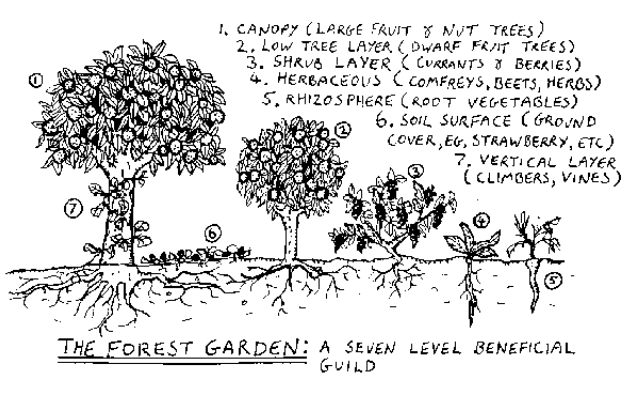
Source: Burnett, G., & Mars, J. (2008). Permaculture: A Beginner’s Guide. [1]
Stacking the Seven Layers
Permaculture works to connect our isolated systems- the vegetable bed, hedges, and perennials,- and makes one interwoven system using a method known as stacking, popularized by authors in the permaculture space. [1] Stacking is about taking these isolated areas and bridging the gap between them like in a natural ecosystem. When you enter a forest, you see large trees in the canopy, but there’s also smaller trees below, and shrubs below those trees. Even closer to the ground, we have herbaceous perennials and vegetables, groundcovers, root vegetables, and vining plants. These categories are what is considered the seven layers of Permaculture. [1] In connecting those layers, we are also utilizing as much space as possible to have a garden with high productivity no matter the space we have. The point is to fill as much space as desired. You’d start with typically a full sun area, so when you plant in layers you can layer the shade-loving plants under your sun lovers. Doing this also creates windblocks and microclimates within your food forest.
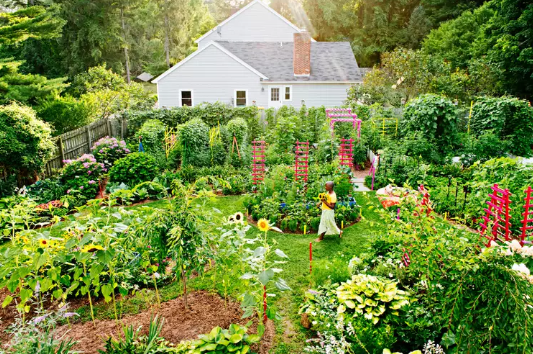
Source: Herman, G., & Landers, L. (2025, November 19). Plant your own permaculture garden with these 12 tips. Better Homes & Gardens. [4]
No Soil Showing
The last key of permaculture we will go over, is leaving no soil showing. This practice naturally minimizes weeds and in turn, lessens how much maintenance the garden will need. This is done by planting ground covers where you can, or adding mulch. Once your garden is established you can consider growing a woody plant to harvest mulch from. Alternatively you can utilize the chop and drop method. [3] Chop and drop is cutting back parts of plants that you would normally prune back and leaving those pieces right where they are or moving them to an area you’d like to cover the soil. The benefit is slowly releasing nitrogen back into the Earth while stopping the germination of weed seeds. In our Intro to Organic Lawn Care article we briefly discuss using this technique with grass clippings after cutting our lawn. To further bridge the two, you can also reuse the grass clippings into your garden beds. If this is unsightly just turn your mulch over it to neaten the look. Never use plant material with pests or disease when utilizing this technique, as you’d risk spreading the problem to other plants. Do not compost them either, they should be disposed of.
Bringing Permaculture Into Your Life
If permaculture is something that has interested you, consider how you can implement it in your own garden and life. It can be as simple as using one technique you learned today, living according to the three core ethics, or creating an entire food forest. At Landscapes by Jeffco, we appreciate the beauty of all landscapes and would love to help you implement permaculture principles into yours if this is something you value. Keep an eye out for more permaculture articles as we explore how to start a permaculture garden, along with practical tips and tricks—from starting a compost to adding biodiversity to your ecosystem.
——————————————————————————————————————————————————————
Text and Photo Sources:
Burnett, G., & Mars, J. (2008). Permaculture: A Beginner’s Guide. https://www.amazon.com/Permaculture-Graham-Burnett/dp/0955349214 (photo and text)
Eliades, A. (2026, February 7). Deep green permaculture. Deep Green Permaculture. https://deepgreenpermaculture.com/ (photo)
Hartley-Simon, A. (2025, October 25). Chop drop and roll: natural ways to increase nitrogen in your garden. UC Agriculture and Natural Resources. https://ucanr.edu/site/uc-marin-master-gardeners/article/chop-drop-and-roll-natural-ways-increase-nitrogen-your (text)
Herman, G., & Landers, L. (2025, November 19). Plant your own permaculture garden with these 12 tips. Better Homes & Gardens. https://www.bhg.com/what-is-a-permaculture-garden-7775333 (photo)
Kasper, D. (n.d.). Permaculture: What is permaculture? Penn State. https://www.e-education.psu.edu/emsc470/node/704 (text)
Sager, M. & OSU Extension Service, Wasco County. (2018). PERMACULTURE BASICS FOR MASTER GARDENERS. In OSU Master Gardener Training 2018. https://extension.oregonstate.edu/sites/default/files/2018-07/permaculture_basics_for_home_gardeners1.pdf (text)